‘Scapegoating’ of Christians the focus of 2026 annual report
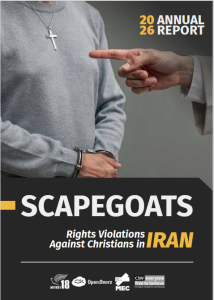
The “scapegoating” of Christians, especially after the 12-day war with Israel, is the focus of the joint annual report on ‘Rights Violations Against Christians in Iran’, published by Middle East Concern, Article18, Open Doors, and CSW.
The report, “Scapegoats”, is published on the anniversary of the murder of Rev Arastoo Sayyah, the first Christian killed for his faith under the Islamic Republic.
The report begins by referring to the protests that erupted at the end of 2025, “calling for an end to the Islamic Republic’s leadership of the country”.
The response to those protests has been horrifying,” it states, “with reports of many thousands killed, including several Christians, and every Iranian – regardless of their religious background – affected.
“The road ahead for Iran appears far from clear, but as we release this latest annual report of rights violations committed against Christians in 2025, we stand with the people of Iran in their call for leaders who will act on their behalf, rather than repress them.
“For 47 years, the Iranian people have been subjected to a regime that not only consistently fails to uphold human rights for its citizens, but brutally quashes dissenting voices, opinions or beliefs. This report details the violations throughout 2025 experienced by just one section of society – the Christian community.”
Key findings
Nearly twice as many Christians were arrested on charges related to their religious beliefs or activities in 2025 as in the previous year – 254 compared to 139.
Meanwhile, more than twice the number of Christians served sentences of imprisonment, exile or forced labour in 2025 (57) than in 2024 (25). Forty-three Christians were still serving sentences at the end of 2025, while a further at least 16 others remained in pre-trial detention.
And although fewer Christians were sentenced in 2025 than the previous year – 96 compared to 73 – the combined total of their sentences (280 years) was higher than in 2024 (263 years), conveying a trend towards harsher sentences.
At least 11 Christians received sentences of 10 years or more in 2025, the report notes, while a total of nine years in exile and 249 years of social deprivation – such as to health, employment or education – were also handed down.
Trends
The report notes that there was a “sharp increase” in arrests of Christians following the 12-day war with Israel, as confirmed in a statement by Iran’s Ministry of Intelligence, which said 53 “trained elements” (referring to evangelical Christians) had been “neutralised”.
Hate speech against Christians and other religious minorities was another trend. The report notes that in August 2025, state media “released a video report showing footage of some of the arrested Christians attending a gathering in Türkiye; screenshots of some of their confiscated items, including New Testaments and other Christian literature; and alleged surveillance recordings of Bibles being “smuggled” into the country.”
Other notable trends included the Islamic Revolutionary Guard Corps’ increasing involvement in arrests of Christians; the targeting of those involved in Bible distribution; severe mistreatment of Christian detainees; consistent use of the amended Article 500 of the penal code – relating to “propaganda contrary to the holy religion of Islam” – to convict Christians; and the monitoring of Christians’ overseas activities, such as attending theological seminars in Turkey.
Recommendations
The report calls for the reopening of the Bible Society, whose “‘temporary closure’ in 1990 remains in force more than 35 years later, and whose reopening would make it unnecessary for Christians to bring Bibles into Iran from abroad”.
It also calls for the “unconditional release of Christians and other religious or belief minorities detained on charges related to their beliefs or religious activities”; the “reopening of forcibly closed churches”; and “clarity on where Persian-speaking Christians may worship freely in their mother tongue, free from fear of arrest and prosecution”.
The report calls on the international community to “hold Iran accountable for failures to fulfil its obligations under international law, including to promote, protect and fulfil freedom of religion or belief (FoRB) for all its citizens”, and for “fair and informed asylum procedures for Iranian Christians seeking international protection, recognising their well-founded fear of persecution if returned”.
Finally, the United Nations, its Special Rapporteurs, and the Independent International Fact-Finding Mission on the Islamic Republic of Iran are asked to “include the situation of Christians (and particularly Christian converts) in all reporting on human rights in [Iran]”, and Member States are encouraged to “speak out against all violations of Iranian Christians’ rights both in public and in private”.
To read the full report, click here